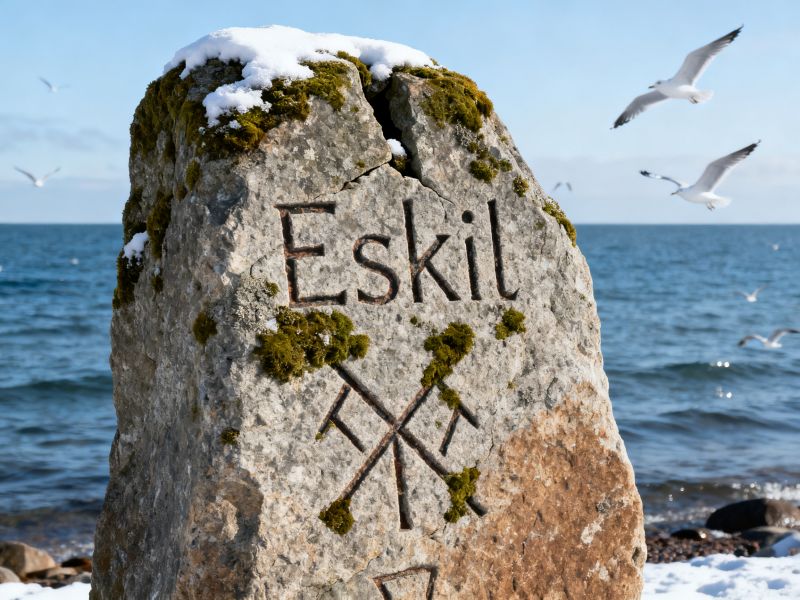
n the far north, where the winter sky bleeds green and violet, the name Eskil refuses to die. You find it on a runestone near Gripsholm, carved in the eleventh century by a man who wanted his brother remembered. You find it in a sauna in Kiruna, where a retired miner named Eskil Andersson tells me, with a laugh。that he was named after a stubborn reindeer. And you find it in the Swedish census records, where the name's frequency drops off a cliff after 1950 — a quiet extinction that mirrors the fate of so many old Norse names.
Eskil is not a decorative name. It comes from Old Norse Ásketill, a compound of áss (god) and ketill (cauldron or helmet). The literal reading — "god-cauldron" — sounds like something from a black metal lyric, but historically it likely meant "helmet of the gods" or "protected by the gods." I first encountered it in a stack of medieval diplomas from the Diocese of Linköping, where an Eskil appears as a witness to a land sale in 1342. His seal, a crude fleur-de-lis。was pressed into wax that has since hardened into something like amber. That physical trace of a man who lived seven centuries ago is what makes the name feel heavy in the mouth.The most famous Eskil is probably Eskil of Lund, the twelfth-century archbishop who clashed with King Sverker over the church's independence. His story is a reminder that this name has always carried a bit of defiance. Danish chronicler Saxo Grammaticus called him vir acer et vehemens — a sharp and vehement man. When I visited Lund Cathedral, the guide pointed to a carved stone, a small, stubborn figure in the crypt。and said, "That's him. Or at least, that's who the local folklore says." Scholarly accuracy aside, the legend fits. Eskil means someone who doesn't back down, even when the king is breathing down his neck.Today, Eskil survives mostly in Sweden, Denmark, and parts of Norway, but it's rare. In 2022, only 1,873 Swedish men bore it as a given name。
according to Statistics Sweden. Most are over sixty. You meet them in places like Årjäng or Härnösand, usually men who work with their hands — farmers, boatbuilders, electricians. I once asked a fisherman in Bohuslän why he thought the name stayed with him. He shrugged and said, "It's a good name for bad weather." That's as good an explanation as any. Names like Eskil don't need a revival movement;they just need one more generation willing to put up with the jokes about Ylvis and the fox.What keeps Eskil alive is not nostalgia but stubbornness. The name doesn't trend on baby-name forums or show up in Netflix dramas. It sits in parish registers and on the lips of old men gutting herring. And maybe that's fine. Not every name needs to be a brand. Some names are just a piece of carved stone, a bit of wax, a lungful of cold air — and the quiet insistence that someone。somewhere, should remember. If you meet an Eskil, ask him about his grandparents. You'll get a story worth hearing.